Spring 2021
- 9 minutes read - 1917 words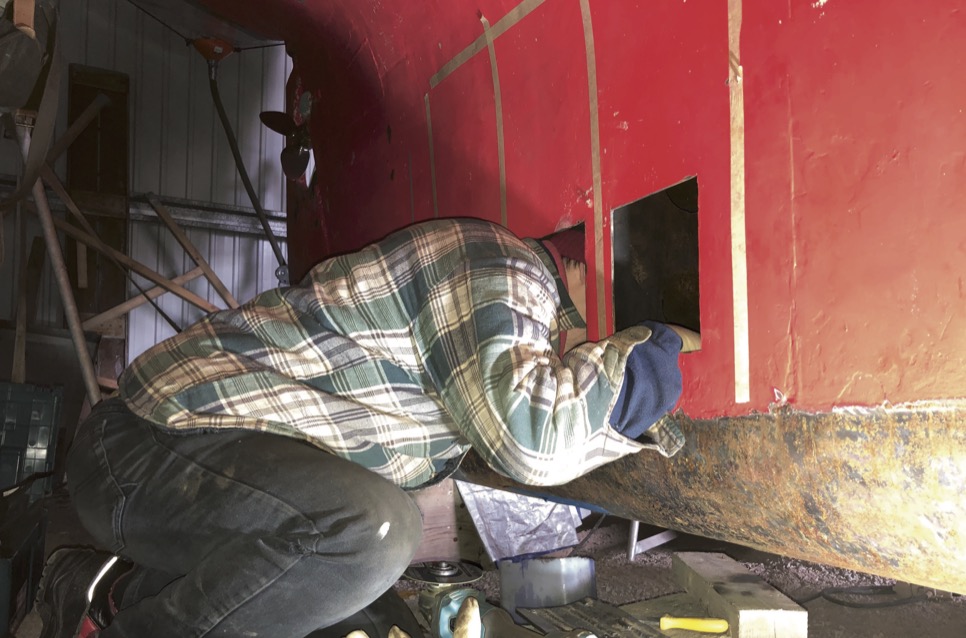
What do I find from here?
The renovation started already in the fall of 2020 when I went through 5 meters of the lower part of the keel.
There were a few holes caused by corrosion in the bottom of the bulk tank and a strange round hole near the deep bilge right in the middle. arc spacing. It looked just like a hole in the bottom plug, but just covered with a package.
The two small holes in the bottom of the bulk tank were not through holes until I brushed off all the rust. Before that, I emptied the contents of the tank into a 200 l barrel because I didn’t want all the good 200 l of diesel to spill out of the small holes onto the ground. The tank emptied easily when I used the transfer pump of the day tank for pumping, the same one that served as the engine’s seawater pump on the Kiel-Hanko sailing. When the tank was empty, it was time to create a workspace, i.e. to facilitate access to the inside of the tank and at the same time to the bottom of the keel. For that, I decided to cut a hole with a wide end going into each arch space of the tank. Since it was a fuel tank and the potential danger of explosion had to be taken into account, I ventilated the tank over several weekends with a car interior space heater that easily fit through the tank’s inspection hatch. With the help of the heater, I was able to dry out the inside of the tank and when the hydrocarbon meter borrowed from the dune also showed zero, I started the squeegee and cut off a piece of approx. 30x30 cm and stuck my head inside.
The idea was to get the tank in order before the start of the spring renovation, i.e. in the winter, but I was wrong. The winter was more normal than the previous one, i.e. the temperatures stayed well below freezing at times and it didn’t really motivate going to the shipyard. In Ariadne, the water tank is also a part of the keel, and in the bow space behind it, there was the previously mentioned strange round approx. 12mm hole. Also in that gap I cut a working hole for the head. In the same way as for the bottom of the bubble tank, I cut off the straight pieces and welded a new 6mm plate instead. In early spring, I spent a couple of days disconnecting the electric windlass. Its aluminum frame had oxidized quite badly and the paint had of course come off, so I wanted to tidy up its appearance and check that it would work. The 15kg delta anchor purchased last summer had not been used yet and I assumed it would be used this summer. The anchor game is bolted to the cover with four bolts, three of which came off with success and the fourth when the cover was drilled out. After disconnecting the cables and wondering for a moment about their connections in the bow, I was able to lift the windlass off and put it on the ground to take home. It’s easy to clean and sand the surface at home so it’ll be finished on time….
The owners of the H-35 in the hangar arrived at the shipyard one spring weekend to paint the bottom with poisons before launching. One of the owners was the former chairman of the Finnish Electrotechnical Association and he told me that the bacteria living on the border between the water and diesel in the tank may form sulfuric acid when I showed him the piece I cut from the bottom of the tank. During the same conversation, he also mentioned one reason why the production of Aura beer in the direction of Turku eventually stopped. The brewery’s production tanks were aluminum and due to corrosion problems, the beer’s aluminum values were above the permitted limits, and therefore the tanks should have been completely renewed. I guess that’s why he drifted into the arms of a bigger brewery.
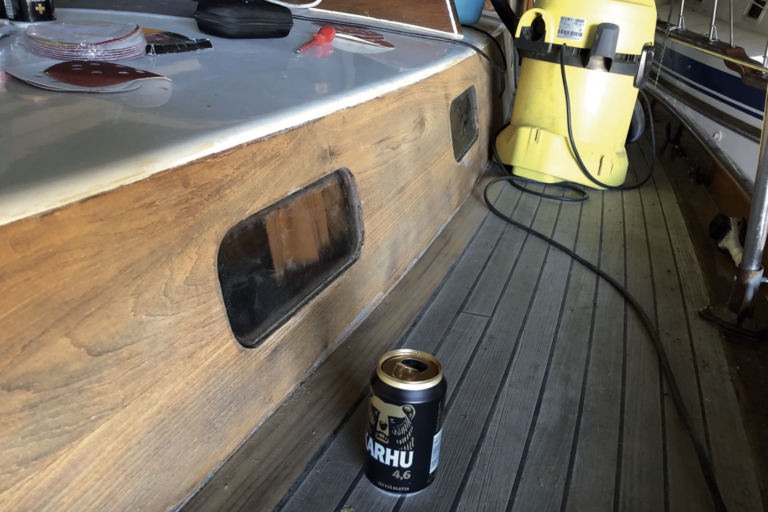
Varnish removed
The window knobs in Ariadne were on the work list for the spring renovation, and that’s why I tore them all off, as well as all the glasses, 17 pieces. After looking at the places of the windows, I came to the conclusion that the old putty and varnish residues must be removed from the places where the windows are embedded, and they must be saturated and well varnished to prevent water damage. And almost at the same time I decided to take the walls of the ruff from the outside completely clean of wood and completely impregnate them. Easy job… a few meters of teak surface with all the varnish and old stain removed, the same for all the window recesses, epoxy and stids in the screw holes of the old frames. In the end, I used up one pound of matches, that is, all the matches I had bought. The material for the new shoes was open for a long time, but in the end I ended up with a plastic, through-dyed putty strip that you could get for a couple of euros per meter. They could have been made of bronze or acid-resistant, but they would have had to be made all one by one, as their dimensions and shape varied slightly. Now I made them from a straight strip that I heated with a hot air fan so that it could be bent into shape in place. The first four or five test songs were spent on practice, after that it was routine.
I first sanded the Ruff walls with 40, then 80 and finally 180 grit sanding discs. After that, I applied the base impregnation and linseed oil mixture countless times over the course of a couple of weeks. During impregnation, I thought about possible staining, but I think the linseed oil changed the color for the better, so staining was not on the to-do list. After impregnation, it was time to start varnishing, directly on the linseed oil surface. I finally applied eight layers of varnish. A few more layers would have been nice, but time was running out. Ariadne’s threshold should also have been done the same, i.e. wood clean, impregnation and varnishing, but I preferred to leave it until the next or another spring in the future.
Anchor winch was - still - waiting at home for cleaning and painting, and at the same time chain was waiting for painting. Lila, who enlisted as an assistant, painted one stripe at 10m, two stripes at 20m and three stripes at 30m on the anchor chain. With their help, it would be easy to estimate how much of the chain has been counted out. Niina painted the frame of the windlass with Inerta 5 and on top of it with Teknodur two-component polyurethane paint. The old action button of the anchor winch fell apart in my hands when I removed it, but luckily I found a suitable water-protected push button on Motonet. The appearance became confusingly like new.
I already sanded the hull above the waterline as usual, and its packages had not liked the winter’s frost again. That’s why I had to remove the old raised surface quite briskly, but strangely only on the port side. On the starboard side, the detachment was limited to a few places and the area was considerably smaller than on the port side. After puttying-sanding them-repositioning puttying-sanding them, I painted the sides with a roller with Epifanes white, and only one 0.75l can of paint was used to paint the sides.
Of course, the snobb stripe had gained wings when I removed the high-gloss surface, and that’s why it had to be repainted in places. Well done, I should have taped and painted one stripe first, let the paint dry and remove the tapes and then the same for the other stripe, but I decided to hurry and skip the drying of the paint. The challenge was that the tape of the second stripe had to be put practically on top of the stripe that had just been painted, but I only pressed it to the edge of the stripe and the end result was tolerable. The holes for the end that I cut to repair the bottom of the keel patiently waited for their welding turn and a few days before launching I welded the pieces I cut back. I had cut them with a grinder with a 1 mm thick blade and the gap was just wide enough to fill the seam sufficiently. As a rule, the seams turned out well, although in a few places, the material’s impurity caused problems, because getting the seam clean required more work.
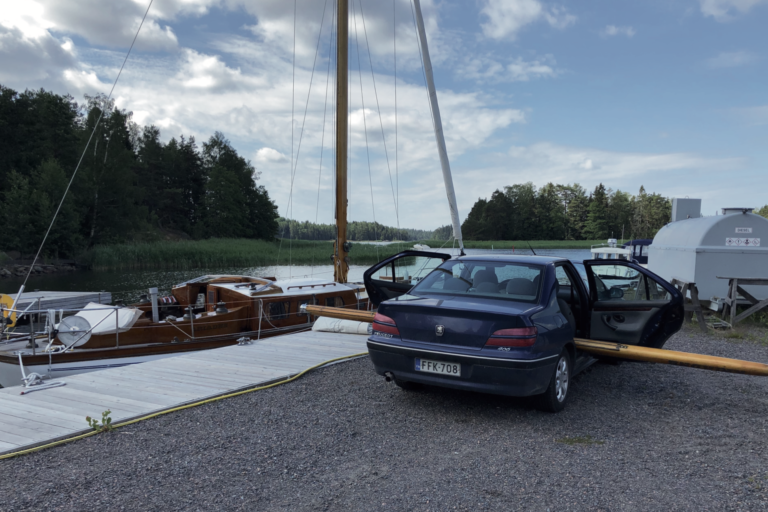
Taking the boom to Ariadne
The original intention was to get all the windows and their shutters fixed before launching, but unfortunately that remained just an idea. Ariadne was launched on June 22. i.e. during midsummer week and the mast was raised right away.
The weather was hot and to celebrate the successful launching and raising of the mast I went to the 5knivar restaurant where the cold beer tasted unbelievably good. Since weather reports had previously predicted nothing but heat for the next several weeks, I wasn’t worried about the lack of windows on the Ariadne. I would have time to fasten them before possible rains……. For the day after the landing, occasional heavy rains were promised starting in the afternoon, so I sweated with the windows in the morning. Before midday, the boss of the shipyard came to encourage us by telling us that it would rain at 12 o’clock. And so it rained, and that was apt to encourage the switch to 5knivar.
Ariadne’s mast has a B&G anemometer sensor equipped with a small solar cell that sends data wirelessly to the anemometer receiver. I put it in place just before lifting the mast. I blindly believed that the sensor will automatically come to life as long as it finds the anemometer receiver. Shouldn’t have believed. The anemometer readings remained missing and the sensor was not found in the system at all. Niina winched me to the mast to get the sensor down and I started to figure out the problem. The sensor’s 2.4V battery was completely empty and it refused to be charged by the solar cell, after all it had already been attached to it for more than a day. Fortunately, the battery was a standard package like the ones webshops had in their offerings, and the price found by googling was a reasonable 12 euros. However, ordering and installation to the mast top seemed rather laborious and I thought I’d try reviving the battery. I connected two 1.5V batteries in series and put a multimeter to measure the current and a switch between the batteries and the battery. At first the current reading was 0mA, but after a few seconds the reading suddenly jumped to 200mA. I left the batteries connected for a while and put the battery back in the sensor. The navigator found the sensor, showed the battery charge level approx. 80% and the wind readings! The job is under treatment, and I went to put the sensor in place with help of Niina and the winch. The monetary saving was not great, but time and effort were a bigger saving.